Saturday, 8 November 2014

Project - Ketchup On Your Cornflakes

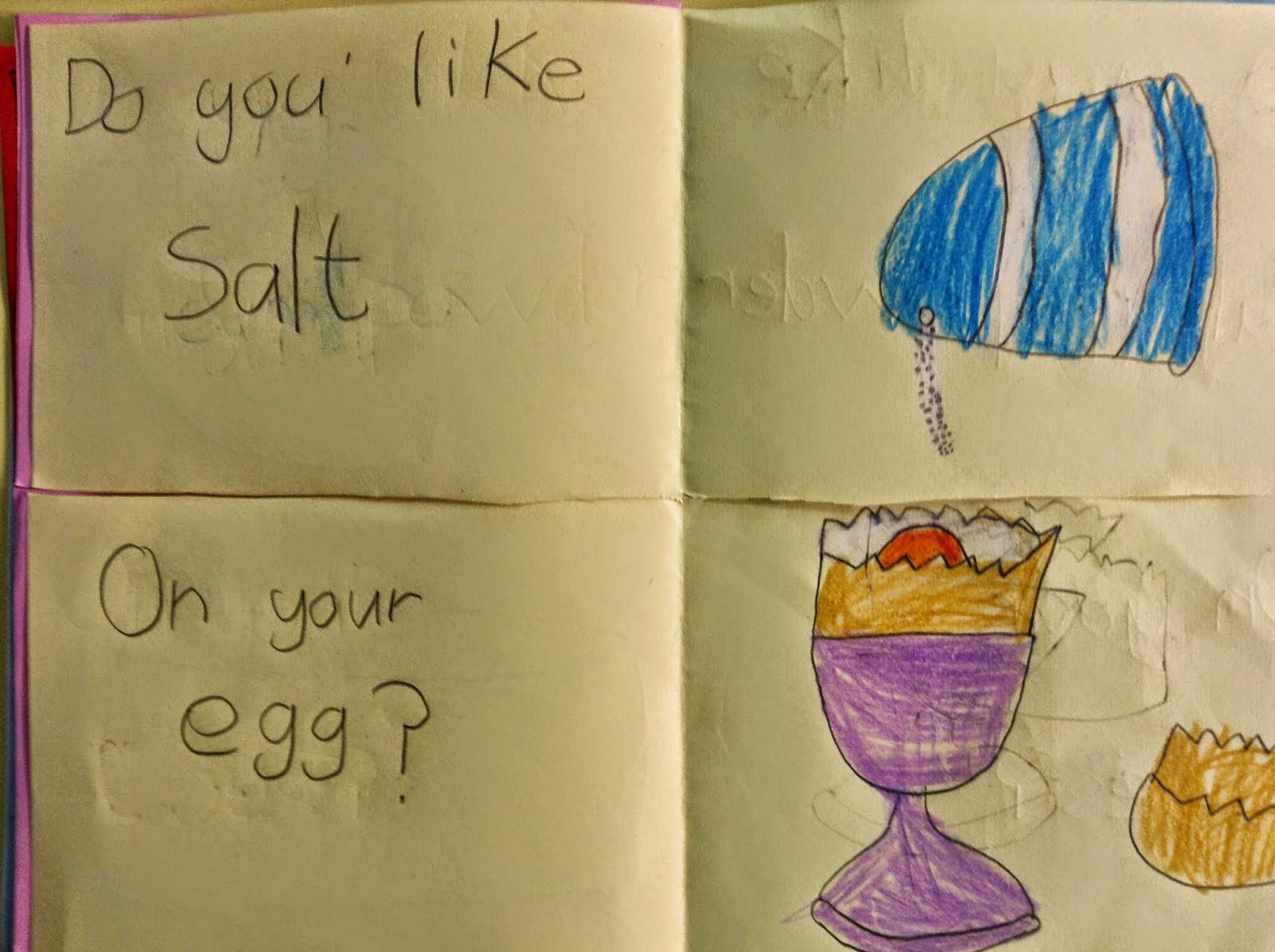
This has been a big hit with my 7 year old students at Santísima Trinidad School (Spain) . The book is divided into moveable top and bottom halves, each with a picture and words. Each moves to create wonderful combinations of things like: "do you like 'woolly hat' on your 'cornflakes'", 'toothpaste' on your 'duck' and 'ketchup' on your 'toes'. It's a great learning tool for getting children to think about what's right and wrong and why and the funny combinations create lots of lovely expressions.


And moreover my students made their  own version of the book in order to practice the communicative function "expressing likes and dislikes". 


Wednesday, 5 November 2014

The Milkmaid

Display any famous painting using your Playmobil stuff and ask your students if it sounds familiar to them. Today I displayed The Milkmaid by Johannes Vermeer. 


Display the real painting and tell your students about the artist and his works.


Describe the painting using THERE IS/ARE, colours, specific vocab... Try to elicit a description of the picture from your students.

Students recreate the painting.


Now you are ready to make the most of the fable The Milkmaid and Her Pail.

Tuesday, 4 November 2014

Alphablocks

Have you ever tried using the Alphablocks in your English Foreign Language lessons?


Alphablocks is the hit CBeebies TV show that’s helping hundreds of thousands of children learn to read. Who better to show you how words work than the alphabet brought to life? The Alphablocks are 26 living letters who discover that whenever they hold hands and make a word, something magical happens. With adventures, songs and silliness, it’s tons of fun with words – all built on a firm foundation of key phonics skills. Alphablocks on TV, online, in print and interactive is a great way to dive into the world of reading.


How to talk so kids can learn at home and in school

Using the unique communication strategies, down-to-earth dialogues, and delightful cartoons that are the hallmark of their multimillion-copy bestseller How to Talk So Kids Will Listen & Listen So Kids Will Talk, Adele Faber and Elaine Mazlish show parents and teachers how to help children handle the everyday problems that interfere with learning. 

Anyone who works with children should use this book as a reference and re-read it every year or two. Not simply because these methods are effective - which they absolutely are, when practiced faithfully - but because Faber and Mazlish promote a style of teaching/parenting that helps a child develop a positive self-image, strong skills of communication, empathy for others, and self-control.

Sunday, 2 November 2014

The case of Grange Primary School, UK

Grange Primary School in the UK is an example and proof for efficiency in changing the present educational system. Children based learning and more real world experiences are needed at schools!
Have a look and listen to Richard Gerver talk about the school with passion!

Saturday, 1 November 2014

See you in Salamanca

Our first transnational project meeting is going to be held in Salamanca (Spain) from 18th to 21st January, 2015


The Underachieving School

John Holt, the “grandfather” of homeschooling, shook up the education establishment and started parents thinking about better ways to teach their children. In this book he lays out his basic arguments about how schools fail our children and offers a wealth of inspiring ideas for what to do about it. 

The Underachieving School is a collection of essays and articles written and compiled by Holt, each brimming with inspiration and ideas on how to teach children. Taking into account how children actually learn, this book shows us the difference between learning and schooling through his original thinking; clear, thoughtful writing; and firsthand accounts of what does and doesn’t work in education. 

“Education is something a person gets for himself, not that which someone else gives or does to him.”

From the book