Sunday, 12 November 2017

Disassembling Tens


In the pictures you can see second grade students working in groups of four: they are using Lego in order to assemble and disassemble numbers in UNITS AND TENS,

TASK 1: 
Student number 1 thinks of a number: i.e. 34

Student number 2 represents the number with Lego blocks. 
                      In this example, he needs three towers of ten  (TENS) and four units.
Student number 3 disassembles one of TENS.
Student number 4 says how many TENS and UNITS there are.
                      In this case, there are 2 TENS and 14 UNITS.

TASK 2: 
Student 1 thinks of a number with TENS and UNITS.
Student 2 thinks of another number with TEN and UNITS.
Student 3 makes the ADDITION.
                      He must bear in mind that if the number of units is bigger than ten, he will have to         assemble a new tower. 
Student 4 says the result, 


Thursday, 9 November 2017

The Police come to School

The police have visited our school. They have explained a lot of things about our safety: when we walk, on a bike, in a car ...


We have really enjoyed the explanations ... but when we have ridden in the police van or on the motorcycles it has been incredible.


Another reason for the presentation to be special was that the policeman who gave it was Alicia's father, one of our classmates. 


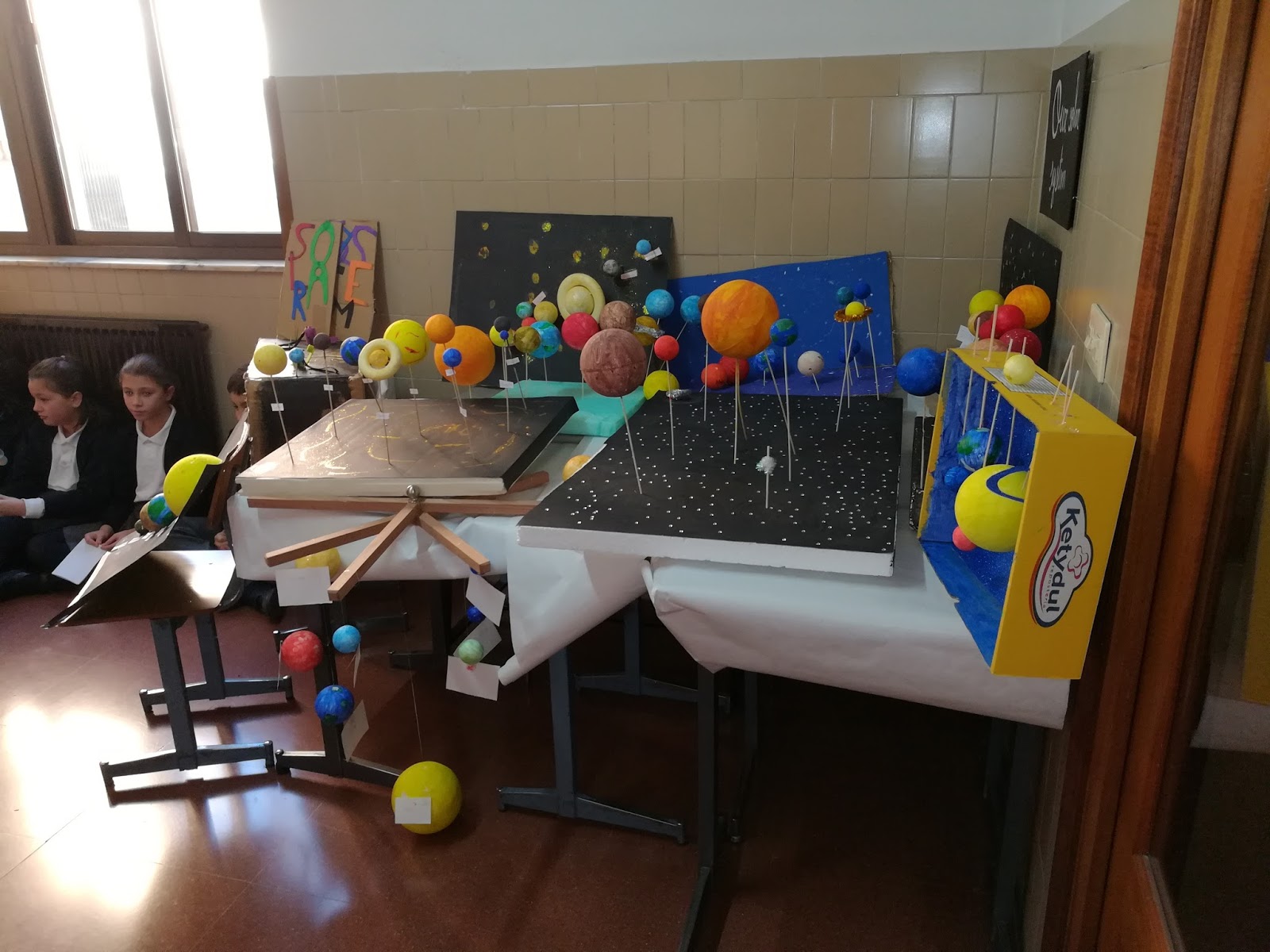
The Solar System.


As you have seen in previous posts, my students in second grade have been studying The Solar System. In the photographs, you can see some representations that have been made using Lego Story Starter.


On the other hand, fifth grade students have carried out a project on the same subject, and have made models to represent the Solar System.


For this reason, today fifth graders have presented their models to second graders.
It has been an experience that the students themselves have valued very positively: some, as public, enjoying the explanations of their older colleagues; and the others because they have had an audience that has enjoyed their models and their explanations. A very positive reinforcement for both learning processes.


Wednesday, 11 October 2017

GEOMETRIC BODIES


Today, in second grade, we have worked collaboratively. The challenge we were asked was how to convert


into geometric bodies.

It is a very difficult  to turn a flat shape into a three-dimensional body

First, draw the flat shape. Then, we took a geometric body and thought about the relationship between flat shape and geometric body. And finally, we try to make bodies in three dimensions. For example, you can get a cube (geometric body) with six squares (flat figure).


Here you have the development of some geometric bodies:


Monday, 9 October 2017

Layers of the Earth

Elementary students have represented the Earth's layers using plasticine. 


They have then put the name of each layer with a label


Patricia Rodríguez and José Ignacio Maide.


Saturday, 7 October 2017

Class Dojo + Lego Minifigures

ClassDojo, from which you have probably heard and read a lot, is a classroom management platform involving both students and teachers as well as parents. One of the most successful educational gamification tools in the world, and in August 2015 exceeded 35 million users. Just type it on Google to find Class Dojo in your language (this is the LINK to the British version).


Its objective is to allow the teacher to manage a school classroom based on scores on the behaviour of the children, offering an open interface, very attractive and simple to use and that, in addition, is customizable to the needs of each classroom, each subject and of each teacher. If a student does a brilliant job he will earn points; on the contrary, if it annoys the companions, we can subtract them to his account. And this is just a couple of examples: in ClassDojo, teachers are the ones who decide what sum, what subtraction and in what amounts, and, of course, it depends on the assignment of all these points.


As you can imagine, this tool is, by itself, quite attractive for children, but to go a little further still, in my second grade classes, we have given a "monetary" value to points and children can change the points by parts of a LEGO MINIFIGURE: for every 20 points they can get the legs, the body or a head. 


When the LEGO MINIFIGURE is complete, they can start buying accessories: helmets, magic wands, animals, hats ...


Everybody; parents, students and teachers are enjoying a lot. The parents of my group who are very cooperative, have bought LEGO MINIFIGURES of each child and then I use them in the classroom u as explained before. 

Monday, 25 September 2017

Geometric shapes


Today, I have worked with my students geometric figures in a fun way. We made groups and each group had a rubber band that they used to create the figure, each of the students was a vertex.