Wednesday, 14 September 2016

More than 100

The children in year 3 learn the numbers above 100.
First they get lots of things to count. They discover the better they bundle them up into tens the better they can count in the end.
So they counted the singles, the tens and the hundreds. They added them and got the whole number.
Its learning by doing and discovering. They worked in teams.
(If you have to count some peas like Cinderella- our kids come and help.)
Janine Herzog


Animals of hands


Our children in class 3 made colored animals with their hands as template and paper. They created birds, peacocks, snakes, dragons, parrots and butterflies. They had a lot of fun and maybe next time they make also other animals. 
Ilona Hartmann/ Janine Herzog


The lego board game from Spain to Germany

Thank you, Maide for the lego board game.
As you know each class in our school has got a LearnToLearn- lego set. One bag for each child.
We used just this bag to play the game. Our children enjoyed it.
About the results: 1 point for the first at finish/ 1 point for the highest counter/ 2 points for the fastest and highest.
Silvia Hoffmann


Job shadowing in our school

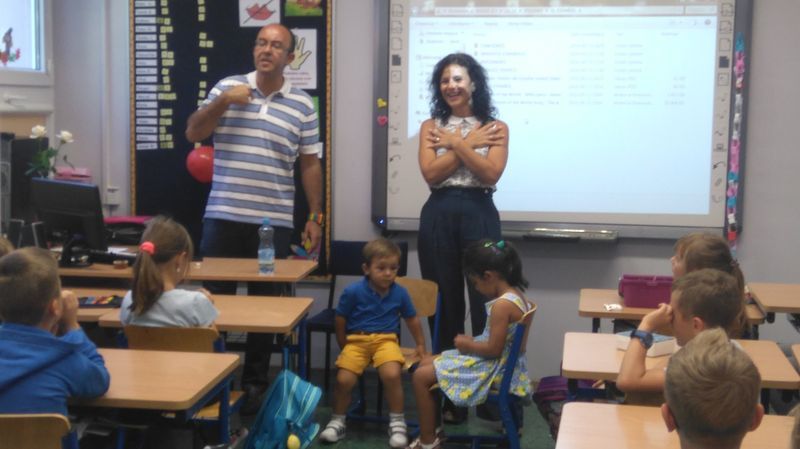
    We are very happy to have wonderful guests at our school who came here thanks to Erasmus+ KA1 to do the job shadowing.
     Jose Ignacio Maide Merino has been actively involved in our school life and he is also a coordinator of our "Creating Tomorrow's Schools Today" project.
     We would like to thank you for all the lesson you taught and good spirit you brought.
     On behalf of our headmisterss, teachers and students: GREAT THANKS. COME BACK ANY TIME YOU WISH. YOU ARE ALWAYS WELCOME.


Tuesday, 13 September 2016

The Dalton Method

While observing  the lesson symmetry-using-lego-more-to-math-and mirrors
Nthe images I share with you below called my attention. Taasks, routines, etc.; are represented through images and clocks where students can clearly see the time require to carry them out.


This is the timer they use. I love this way of working with time, as I constantly use the stopwatch in class. However, I did not know this method.


This is another idea I liked very much. The red light means that students are not allow to ask any question; the yellow one allows them to ask questions to other students; and finally, the green light means that student can ask the teacher. To my surprise, when the light is green, very few questions are asked to the teacher. As a conclusion, I think students are working more autonomously and are less dependent on the teacher. 


In the following image you can find a summary of this way of working (taken from VISUALIZING DALTON). Hope you find it useful. I think I will try it with my young learners when I am back to Spain). 


Monday, 12 September 2016

Symmetry (using LEGO MORE TO MATH and mirrors)

Wonderful lesson and woderful way so that children get the idea and work on symmetry. 
First, the teacher introduces the concept.


When students get the concept, they start working on producing symmetric patterns. They build whatever they like to, using LEGO MORE TO MATH. 


Then, with the help of a mirror, they check what they have to build so that bouth constructions are symmetric:


Sunday, 4 September 2016

Acercando Aulas

I would like to share with you this link:


("bringing our classrooms together," so to say). This is the badge you may have seen in our blog, showing that we collaborate wit them:


 It is a blog that shares etwinning projects. 

 In this link:


you will find an entry in which share our great project:

Friday, 26 August 2016

Lego Math Game

I can not resist sharing this fantastic game.


The object is to build the highest tower. 


I leave the blog where you you can download the templates: