

Sunday, 5 April 2015

Saturday, 4 April 2015
Short plays made with Playmobil
Year 5 pupils have been learning about theatre plays and its characteristics so they created a short play written by themselves and performed with some Playmobil. They worked hard to prepare the videos so they hope you will like them.
Board Games to learn Verbs
We all know how hard it is to learn the verbal conjugation in Spanish. To make it easier and funnier, our students have created games to practice the verb tenses. They have taken popular board games as a model and have designed their own ones with their own instructions.
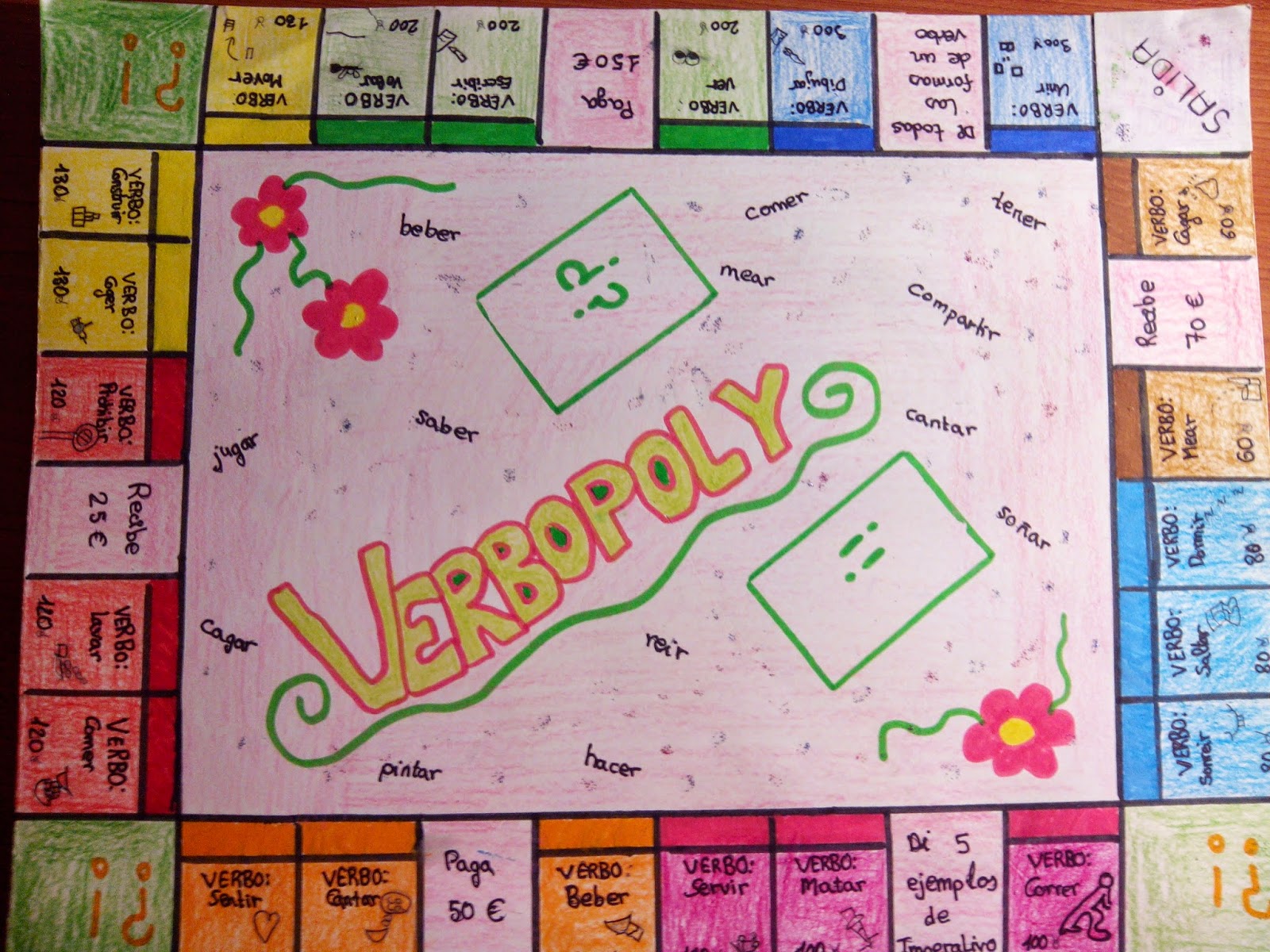


It has been also a very good way of practising the instructive type of text. How do we give instructions or orders in our language? Then we did the same in English. The result was spectacular and everybody was practising without noticing they were doing grammar or writing. This activity was done with students of 2nd ESO and the best thing is that I could use it with my 1st of ESO students too and they were really delighted.
By Soledad González
LEGO Bricks used to practice Morphology
Following Soledad's idea "Word Rainbow", year 5 pupils are working morphology with Lego Bricks. This way they can easily identify them and also, touch them and combine them in different ways. Even the pupils who usually have difficulties with language enjoyed building sentences with the help of bricks.


Word Rainbow
Students of 2nd ESO have created posters of types of words
using a “Colour Code” that we have called "Word Rainbow". I took this idea from the Reading Rods by Learning Resources
Then, they presented the posters to the 1st ESO students. We
have also used this code to compare the four different languages that are
learnt at school : German, French, English and Spanish.


Among other things,
students could notice the differences in word and sentence order. For this activity we have chosen the same
text translated into the four languages that they study. It was taken from the novel Momo, by Michael Ende.
The best thing of this activity is that it can be adapted to
any level. We have decided to use this colour code for Spanish syntax too, as students have really enjoyed all the activities.
By Soledad González
French and English expressions
Pupils from CE2 (aged 8) worked on expressions with animals. They had to guess the meaning of expressions such as:
- A dog's life
- It´s raining dogs and cats
- To be a chicken
- When pigs might fly
- Not be a happy bunny
We compared the two languages trying to see if we used the same animals to express the same idea.Children had a lot of fun.

Friday, 3 April 2015


Thursday, 2 April 2015
Let's observe our classroom!
Through this activity children do some concrete experiences to learn to observe and represent objects and known spaces from different perspectives. They recognize the position of themselves and objects in a room and discover the relationship between the different points of views in the observation and the way in which the objects and a space are represented.The children have worked both individually and in small groups.
Each child individually has represented the classroom respect to the position of own desk. The children have drawn it in a different way, according to their point of view. We have discussed and compared the drawings in relation to our position in the classroom.

From the first line

From the middle line

From the bottom line
Children have changed their position in the classroom to observe the desk in front, from above, from below and by side. They have represented and built in small groups what they have seen according to the different perspectives of observation.


Front view

Top view Bottom view
The next step was to chose together the symbols to represent and build the map of the classroom. The children have identified the symbols of the map legend using and counting the squares of their notebook. They have considered the size of the desk at first drawn as reference to represent proportionally the other furnishings of the room.

The map legend
Individually they have represented classroom 2A on the notebook

In small groups they have built the map of the classroom using the Lego bricks


Our classroom as seen from above
In the end we have also learned some new English words

The children have worked in this activity showing interest, precision and a good potential of symbolization. It was a complete job related to many subjects: geography, maths, geometry, technology, arts and English too.
Subscribe to:
Posts (Atom)